Page last modified

January 6, 2026

Learning objectives:

  • Learn about the time series inspection approach.
  • Understand how to implement this approach.

Pre-reading:

This page continues on from: Replications.

Entity generation → Entity processing → Initialisation bias → Performance measures → Replications → Length of warm-up

Required packages:

These should be available from environment setup on the Structuring as a package page.

import os

from IPython.display import HTML
from itables import to_html_datatable
import numpy as np
import pandas as pd
import plotly.express as px
import plotly.graph_objects as go
import scipy.stats as st
import simpy
from sim_tools.distributions import Exponential
library(dplyr)
library(ggplot2)
library(gridExtra)
library(knitr)
library(plotly)
library(R6)
library(simmer)
library(tidyr)

Determining a suitable length of warm-up

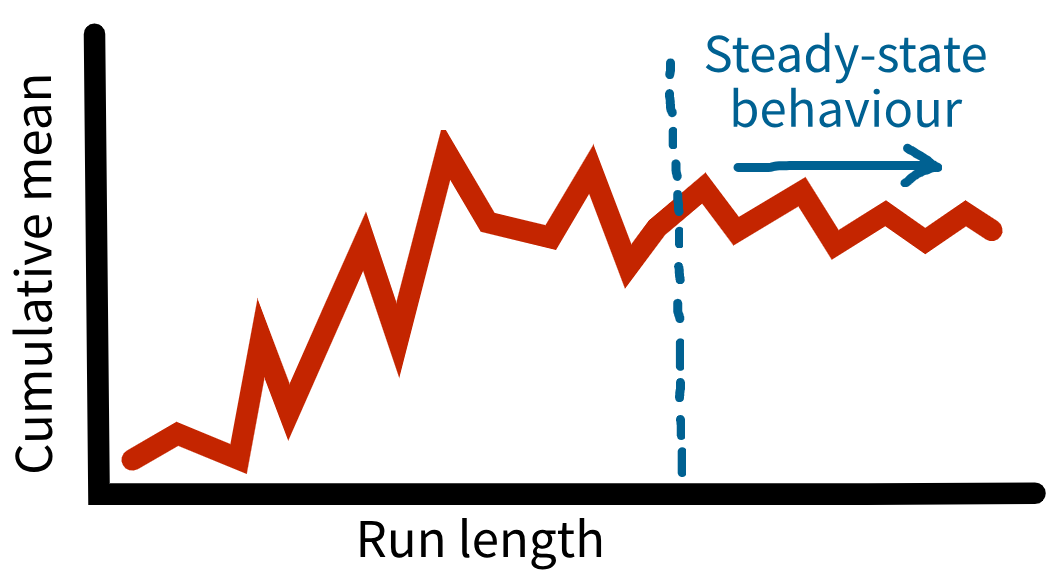
A warm-up period helps address initialisation bias, which occurs when a simulation begins in an “empty” state that doesn’t reflect how the real system usually operates. In this early phase, performance measures can be unusually high or low because the system hasn’t yet settled into typical conditions. Running the model for a warm-up period before collecting results allows it to reach steady-state behaviour - a stage where performance measures are stable and represent typical, ongoing behaviour.

Many different methods have been proposed for determining a suitable length of warm-up - the simplest is the time series inspection approach. This involves looking at performance measures over time to identify when the system is exhibiting steady state behaviour (even though the system will never truly reach a “steady state”).

We could plot mean results over time, but this would fluctuate too much. Instead, we plot the cumulative mean of the performance measures over time. We then look for the point where this smoothes out and stabilises - this indicates where your warm-up period should end (Robinson (2007)).
When determining your warm-up period, you should:

  • Run the model with multiple replications (at least five) (Robinson (2007)).
  • Use a long run length (e.g., 5-10 times your planned simulation length).
  • Use your base case parameters (and, if these changes, re-assess the appropriate warm-up period).

Choice of an appropriate warm-up length forms part of your model experimentation validation (see verification and validation page).

Implementing the time series inspection approach

It’s important to include all relevant metrics when implementing this approach. For our model, that means:

  • Mean wait time
  • Mean doctor utilisation
  • Mean queue length
  • Mean time in system
  • Mean number of patients in system

Why not other metrics?

  • Total arrivals: Not impacted by initialisation bias
  • Mean time in consultation: Not impacted by initialisation bias
  • Unseen (backlogged) patients: In the current model set-up, number of unseen patients is very low or zero, so this is not that useful in our consideration of initialisation bias. However, if your model configuration leads to significant backlogs, this metric could become relevant for warm-up analysis.


For this approach, we need to track the performance measures as the simulation runs. This allows us to identify when the system reaches steady state. There are a few ways you might consider implementing this.

Approach 1. Extract data from existing lists

During the simulation run, many performance measures are already recorded and stored in lists, along with their corresponding event times. We could extract and process these but:

  • Requires extensive changes to Runner - in particular, to extract time-weighted metrics during the run. These require helper methods to compute and summarise the metrics. Other methods are needed to process and output the results.
  • Runner becomes quite cluttered - it then contains code to execute replications, aggregate final results, and now to handle time-series extraction and processing (when we only need this code for this analysis, and not anything else).
  • ❌ This would collect data from every event (potentially tens-of-thousands of timepoints!). For warm-up analysis, collecting data at regular intervals is sufficient.

Approach 2. Separate WarmupAuditor class

We can create a dedicated WarmupAuditor class that runs in parallel with the simulation. It samples performance measures at regular intervals. Benefits of this approach are:

  • No changes needed to the original simulation code (Model, Runner, Parameters, etc.).
  • ✅ All warm-up analysis logic is separate and self-contained, making it easier to understand, maintain, reuse or remove as needed.
  • ✅ Data is collected efficiently - only at the required intervals, not every event - producing smaller, more manageable datasets.

This is the approach we have used.

Acknowledgements: This auditor-based strategy is adapted from Tom Monks (2024) Lab 6 Output Analysis in HPDM097 - Making a difference with health data (MIT Licence).

Approach 3. Adding audit methods to Model

You might be tempted to implement the warm-up auditor as a method within Model, but we would recommend against this.

  • Model becomes quite cluttered - it should represent core simulation logic (patient arrivals, resource usage, etc.) - but now also have warm-up analysis methods mixed in.
  • ❌ This analysis is only performed during initial model development, and not during production runs or scenario analysis, so there is no need for it to be in the main model definition.

Simulation code

The simulation being used is that from the Replications page, with no changes required.

class Parameters:
    """
    Parameter class.

    Attributes
    ----------
    interarrival_time : float
        Mean time between arrivals (minutes).
    consultation_time : float
        Mean length of doctor's consultation (minutes).
    number_of_doctors : int
        Number of doctors.
    warm_up_period : int
        Duration of the warm-up period (minutes).
    data_collection_period : int
        Duration of the data collection period (minutes).
    number_of_runs : int
        The number of runs (i.e., replications).
    verbose : bool
        Whether to print messages as simulation runs.
    """
    def __init__(
        self, interarrival_time=5, consultation_time=10,
        number_of_doctors=3, warm_up_period=30, data_collection_period=40,
        number_of_runs=5, verbose=False
    ):
        """
        Initialise Parameters instance.

        Parameters
        ----------
        interarrival_time : float
            Time between arrivals (minutes).
        consultation_time : float
            Length of consultation (minutes).
        number_of_doctors : int
            Number of doctors.
        warm_up_period : int
            Duration of the warm-up period (minutes).
        data_collection_period : int
            Duration of the data collection period (minutes).
        number_of_runs : int
            The number of runs (i.e., replications).
        verbose : bool
            Whether to print messages as simulation runs.
        """
        self.interarrival_time = interarrival_time
        self.consultation_time = consultation_time
        self.number_of_doctors = number_of_doctors
        self.warm_up_period = warm_up_period
        self.data_collection_period = data_collection_period
        self.number_of_runs = number_of_runs
        self.verbose = verbose
class Patient:
    """
    Represents a patient.

    Attributes
    ----------
    patient_id : int
        Unique patient identifier.
    period : str
        Arrival period (warm up or data collection) with emoji.
    arrival_time : float
        Time patient entered the system (minutes).
    wait_time : float
        Time spent waiting for the doctor (minutes).
    time_with_doctor : float
        Time spent in consultation with a doctor (minutes).
    end_time : float
        Time that patient leaves (minutes), or NaN if remain in system.
    """
    def __init__(self, patient_id, period, arrival_time):
        """
        Initialises a new patient.

        Parameters
        ----------
        patient_id : int
            Unique patient identifier.
        period : str
            Arrival period (warm up or data collection) with emoji.
        arrival_time : float
            Time patient entered the system (minutes).
        """
        self.patient_id = patient_id
        self.period = period
        self.arrival_time = arrival_time
        self.wait_time = np.nan
        self.time_with_doctor = np.nan
        self.end_time = np.nan
class MonitoredResource(simpy.Resource):
    """
    SimPy Resource subclass that tracks utilisation, queue length and mean
    number of patients in the system.

    Attributes
    ----------
    time_last_event : list
        Time of the most recent resource request or release event.
    area_resource_busy : list
        Cumulative time resources were busy, for computing utilisation.
    area_n_in_queue : list
        Cumulative time patients spent queueing for a resource, for
        computing average queue length.

    Notes
    -----
    Class adapted from Monks, Harper and Heather 2025.
    """

    def __init__(self, *args, **kwargs):
        """
        Initialise the MonitoredResource, resetting monitoring statistics.

        Parameters
        ----------
        *args :
            Positional arguments to be passed to the parent class.
        **kwargs :
            Keyword arguments to be passed to the parent class.
        """
        # Initialise a SimPy Resource
        super().__init__(*args, **kwargs)
        # Run the init_results() method
        self.init_results()

    def init_results(self):
        """
        Reset monitoring attributes.
        """
        self.time_last_event = [self._env.now]
        self.area_resource_busy = [0.0]
        self.area_n_in_queue = [0.0]

    def request(self, *args, **kwargs):
        """
        Update time-weighted statistics before requesting a resource.

        Parameters
        ----------
        *args :
            Positional arguments to be passed to the parent class.
        **kwargs :
            Keyword arguments to be passed to the parent class.

        Returns
        -------
        simpy.events.Event
            Event for the resource request.
        """
        # Update time-weighted statistics
        self.update_time_weighted_stats()
        # Request a resource
        return super().request(*args, **kwargs)

    def release(self, *args, **kwargs):
        """
        Update time-weighted statistics before releasing a resource.

        Parameters
        ----------
        *args :
            Positional arguments to be passed to the parent class.
        **kwargs :
            Keyword arguments to be passed to the parent class.

        Returns
        -------
        simpy.events.Event
            Event for the resource release.
        """
        # Update time-weighted statistics
        self.update_time_weighted_stats()
        # Release a resource
        return super().release(*args, **kwargs)

    def update_time_weighted_stats(self):
        """
        Update the time-weighted statistics for resource usage.

        Notes
        -----
        - These sums can be referred to as "the area under the curve".
        - They are called "time-weighted" statistics as they account for how
          long certain events or states persist over time.
        """
        # Calculate time since last event
        time_since_last_event = self._env.now - self.time_last_event[-1]

        # Add record of current time
        self.time_last_event.append(self._env.now)

        # Add "area under curve" of resources in use
        # self.count is the number of resources in use
        self.area_resource_busy.append(self.count * time_since_last_event)

        # Add "area under curve" of people in queue
        # len(self.queue) is the number of requests queued
        self.area_n_in_queue.append(len(self.queue) * time_since_last_event)
class Model:
    """
    Simulation model.

    Attributes
    ----------
    param : Parameters
        Simulation parameters.
    run_number : int
        Run number for random seed generation.
    env : simpy.Environment
        The SimPy environment for the simulation.
    doctor : simpy.Resource
        SimPy resource representing doctors.
    patients : list
        List of Patient objects.
    results_list : list
        List of dictionaries with the attributes of each patient.
    area_n_in_system : list of float
        List containing incremental area contributions used for
        time-weighted statistics of the number of patients in the system.
    time_last_n_in_system : float
        Simulation time at last update of the number-in-system statistic.
    n_in_system: int
        Current number of patients present in the system, including
        waiting and being served.
    arrival_dist : Exponential
        Distribution used to generate random patient inter-arrival times.
    consult_dist : Exponential
        Distribution used to generate length of a doctor's consultation.
    """
    def __init__(self, param, run_number):
        """
        Create a new Model instance.

        Parameters
        ----------
        param : Parameters
            Simulation parameters.
        run_number : int
            Run number for random seed generation.
        """
        self.param = param
        self.run_number = run_number

        # Create SimPy environment
        self.env = simpy.Environment()

        # Create resource
        self.doctor = MonitoredResource(
            self.env, capacity=self.param.number_of_doctors
        )

        # Create a random seed sequence based on the run number
        ss = np.random.SeedSequence(self.run_number)
        seeds = ss.spawn(2)

        # Set up attributes to store results
        self.patients = []
        self.results_list = []
        self.area_n_in_system = [0]
        self.time_last_n_in_system = self.env.now
        self.n_in_system = 0

        # Initialise distributions
        self.arrival_dist = Exponential(mean=self.param.interarrival_time,
                                        random_seed=seeds[0])
        self.consult_dist = Exponential(mean=self.param.consultation_time,
                                        random_seed=seeds[1])

    def update_n_in_system(self, inc):
        """
        Update the time-weighted statistics for number of patients in system.

        Parameters
        ----------
        inc : int
            Change in the number of patients (+1, 0, -1).
        """
        # Compute time since last event and calculate area under curve for that
        duration = self.env.now - self.time_last_n_in_system
        self.area_n_in_system.append(self.n_in_system * duration)
        # Update time and n in system
        self.time_last_n_in_system = self.env.now
        self.n_in_system += inc

    def generate_arrivals(self):
        """
        Process that generates patient arrivals.
        """
        while True:
            # Sample and pass time to next arrival
            sampled_iat = self.arrival_dist.sample()
            yield self.env.timeout(sampled_iat)

            # Check whether arrived during warm-up or data collection
            if self.env.now < self.param.warm_up_period:
                period = "\U0001F538 WU"
            else:
                period = "\U0001F539 DC"

            # Create a new patient
            patient = Patient(patient_id=len(self.patients)+1,
                              period=period,
                              arrival_time=self.env.now)
            self.patients.append(patient)

            # Update the number in the system
            self.update_n_in_system(inc=1)

            # Print arrival time
            if self.param.verbose:
                print(f"{patient.period} Patient {patient.patient_id} " +
                      f"arrives at time: {patient.arrival_time:.3f}")

            # Start process of consultation
            self.env.process(self.consultation(patient))

    def consultation(self, patient):
        """
        Process that simulates a consultation.

        Parameters
        ----------
        patient :
            Instance of the Patient() class representing a single patient.
        """
        start_wait = self.env.now
        # Patient requests access to a doctor (resource)
        with self.doctor.request() as req:
            yield req

            # Record how long patient waited before consultation
            patient.wait_time = self.env.now - start_wait

            if self.param.verbose:
                print(f"{patient.period} Patient {patient.patient_id} " +
                      f"starts consultation at: {self.env.now:.3f}")

            # Sample consultation duration and pass time spent with doctor
            patient.time_with_doctor = self.consult_dist.sample()
            yield self.env.timeout(patient.time_with_doctor)

            # Update number in system
            self.update_n_in_system(inc=-1)

            # Record end time
            patient.end_time = self.env.now
            if self.param.verbose:
                print(f"{patient.period} Patient {patient.patient_id} " +
                      f"leaves at: {patient.end_time:.3f}")

    def reset_results(self):
        """
        Reset results.
        """
        self.patients = []
        self.doctor.init_results()
        # For number in system, we reset area and time but not the count, as
        # it should include any remaining warm-up patients in the count
        self.area_n_in_system = [0]
        self.time_last_n_in_system = self.env.now

    def warmup(self):
        """
        Reset result collection after the warm-up period.
        """
        if self.param.warm_up_period > 0:
            # Delay process until warm-up period has completed
            yield self.env.timeout(self.param.warm_up_period)
            # Reset results variables
            self.reset_results()
            if self.param.verbose:
                print(f"Warm up period ended at time: {self.env.now}")

    def run(self):
        """
        Run the simulation.
        """
        # Schedule arrival generator and warm-up
        self.env.process(self.generate_arrivals())
        self.env.process(self.warmup())

        # Run the simulation
        self.env.run(until=(self.param.warm_up_period +
                            self.param.data_collection_period))

        # At simulation end, update time-weighted statistics by accounting
        # for the time from the last event up to the simulation finish.
        self.doctor.update_time_weighted_stats()

        # Run final calculation of number in system
        self.update_n_in_system(inc=0)

        # Create list of dictionaries containing each patient's attributes
        self.results_list = [x.__dict__ for x in self.patients]
def summary_stats(data):
    """
    Calculate mean, standard deviation and 95% confidence interval (CI).

    Parameters
    ----------
    data : pd.Series
        Data to use in calculation.

    Returns
    -------
    tuple
        (mean, standard deviation, CI lower, CI upper).
    """
    # Remove any NaN from the series
    data = data.dropna()

    # Find number of observations
    count = len(data)

    # If there are no observations, then set all to NaN
    if count == 0:
        mean, std_dev, ci_lower, ci_upper = np.nan, np.nan, np.nan, np.nan
    # If there is only one or two observations, can do mean but not others
    elif count < 3:
        mean = data.mean()
        std_dev, ci_lower, ci_upper = np.nan, np.nan, np.nan
    # With more than one observation, can calculate all...
    else:
        mean = data.mean()
        std_dev = data.std()
        # Special case for CI if variance is 0
        if np.var(data) == 0:
            ci_lower, ci_upper = mean, mean
        else:
            # Calculation of CI uses t-distribution, which is suitable for
            # smaller sample sizes (n<30)
            ci_lower, ci_upper = st.t.interval(
                confidence=0.95,
                df=count-1,
                loc=mean,
                scale=st.sem(data))
    return mean, std_dev, ci_lower, ci_upper
class Runner:
    """
    Run the simulation.

    Attributes
    ----------
    param : Parameters
        Simulation parameters.
    """
    def __init__(self, param):
        """
        Initialise a new instance of the Runner class.

        Parameters
        ----------
        param : Parameters
            Simulation parameters.
        """
        self.param = param

    def run_single(self, run):
        """
        Runs the simulation once and performs results calculations.

        Parameters
        ----------
        run : int
            Run number for the simulation.

        Returns
        -------
        dict
            Contains patient-level results and results from each run.
        """
        model = Model(param=self.param, run_number=run)
        model.run()

        # Patient results
        patient_results = pd.DataFrame(model.results_list)
        patient_results["run"] = run
        patient_results["time_in_system"] = (
            patient_results["end_time"] - patient_results["arrival_time"]
        )
        # For each patient, if they haven't seen a doctor yet, calculate
        # their wait as current time minus arrival, else set as missing
        patient_results["unseen_wait_time"] = np.where(
            patient_results["time_with_doctor"].isna(),
            model.env.now - patient_results["arrival_time"], np.nan
        )

        # Run results
        run_results = {
            "run_number": run,
            "arrivals": len(patient_results),
            "mean_wait_time": patient_results["wait_time"].mean(),
            "mean_time_with_doctor": (
                patient_results["time_with_doctor"].mean()
            ),
            "mean_utilisation_tw": (
                sum(model.doctor.area_resource_busy) / (
                    self.param.number_of_doctors *
                    self.param.data_collection_period
                )
            ),
            "mean_queue_length": (
                sum(model.doctor.area_n_in_queue) /
                self.param.data_collection_period
            ),
            "mean_time_in_system": patient_results["time_in_system"].mean(),
            "mean_patients_in_system": (
                sum(model.area_n_in_system) /
                self.param.data_collection_period
            ),
            "unseen_count": patient_results["time_with_doctor"].isna().sum(),
            "unseen_wait_time": patient_results["unseen_wait_time"].mean()
        }

        return {
            "patient": patient_results,
            "run": run_results
        }

    def run_reps(self):
        """
        Execute a single model configuration for multiple runs.

        Returns
        -------
        dict
            Contains patient-level results, results from each run and
            overall results.
        """
        # Run replications
        all_results = [self.run_single(run)
                       for run in range(self.param.number_of_runs)]

        # Separate results from each run into appropriate lists
        patient_results_list = [result["patient"] for result in all_results]
        run_results_list = [result["run"] for result in all_results]

        # Convert lists into dataframes
        patient_results_df = pd.concat(
            patient_results_list, ignore_index=True
        )
        run_results_df = pd.DataFrame(run_results_list)

        # Calculate average results and uncertainty from across all runs
        uncertainty_metrics = {}
        run_col = run_results_df.columns

        # Loop through the run performance measure columns
        # Calculate mean, standard deviation and 95% confidence interval
        for col in run_col[~run_col.isin(["run_number", "scenario"])]:
            uncertainty_metrics[col] = dict(zip(
                ["mean", "std_dev", "lower_95_ci", "upper_95_ci"],
                summary_stats(run_results_df[col])
            ))
        # Convert to dataframe
        overall_results_df = pd.DataFrame(uncertainty_metrics)

        return {
            "patient": patient_results_df,
            "run": run_results_df,
            "overall": overall_results_df
        }

Auditor class

The WarmupAuditor class is created by passing a Model instance and an interval (in minutes). The run() method starts both the auditor process (using self.model.env.process()) and the simulation (self.model.run()).

The audit process _audit_model() runs continuously throughout the simulation, collecting performance measures at the specified intervals. It calls dedicated methods for each metric that calculate the cumulative mean at that timepoint (e.g., _get_wait_time(), _get_utilisation()).

The results are stored as a list of dictionaries in audit_results, with one entry per interval containing the simulation time and all five performance measures.

class WarmupAuditor():
    """
    Warm-up auditor for the model.
    Records cumulative mean results at regular intervals.

    Attributes
    ----------
    model : Model
        Instance of Model() to run the simulation.
    interval : int
        Audit frequency (minutes).
    audit_results : list
        List of dictionaries containing audit snapshots at each interval.
    current_time : int
        Current simulation time to perform audit.
    """
    def __init__(self, model, interval):
        """
        Initialise auditor.

        Parameters
        ----------
        model : Model
            Instance of Model() to run the simulation.
        interval : int
            Audit frequency (minutes).
        """
        self.model = model
        self.interval = interval
        self.audit_results = []
        self.current_time = np.nan

    def run(self):
        """
        Run auditor alongside simulation model.
        """
        self.model.env.process(self._audit_model())
        self.model.run()

    def _audit_model(self):
        """
        Audit the model at the specified intervals.
        """
        while True:
            self.current_time = self.model.env.now
            self.audit_results.append({
                "time": self.current_time,
                "wait_time": self._get_wait_time(),
                "time_in_system": self._get_time_in_system(),
                "queue_length": self._get_queue_length(),
                "utilisation": self._get_utilisation(),
                "patients_in_system": self._get_patients_in_system()
            })
            yield self.model.env.timeout(self.interval)

    def _get_wait_time(self):
        """
        Compute mean wait time for patients seen by current time.

        Returns
        -------
        float
            Mean wait time across all patients who have been seen.
        """
        wait_times = [
            patient.wait_time
            for patient in self.model.patients
            if not np.isnan(patient.wait_time)
        ]
        if wait_times:
            return np.mean(wait_times)
        return np.nan

    def _get_time_in_system(self):
        """
        Compute mean time in system (for patients completed by current time).

        Returns
        -------
        float
            Mean time in system for patients completed by current time.
        """
        time_in_system = []
        for patient in self.model.patients:
            if not np.isnan(patient.end_time):
                time_in_system.append(patient.end_time - patient.arrival_time)
        if time_in_system:
            return np.mean(time_in_system)
        return np.nan

    def _get_queue_length(self):
        """
        Compute time-weighted mean queue length up to current time.

        Returns
        -------
        float
            Time-weighted mean queue length from start to current time.
        """
        total_area = sum(self.model.doctor.area_n_in_queue)
        if self.current_time > 0:
            return total_area / self.current_time
        return 0

    def _get_utilisation(self):
        """
        Compute time-weighted mean utilisation up to current time.

        Returns
        -------
        float
            Time-weighted mean utilisation from start to current time.
        """
        total_area = sum(self.model.doctor.area_resource_busy)
        total_capacity = self.model.param.number_of_doctors * self.current_time
        if self.current_time > 0:
            return total_area / total_capacity
        return 0

    def _get_patients_in_system(self):
        """
        Computer time-weighted mean patients in system up to current time.

        Returns
        -------
        float
            Time-weighted mean patients in system from start to current time.
        """
        total_area = sum(self.model.area_n_in_system)
        if self.current_time > 0:
            return total_area / self.current_time
        return 0

Run model with auditor

It’s important to run the time series inspection on results from multiple replications. The run_warmup_analysis() function executes WarmupAuditor for the specified number of replications, and returns the results as a single dataframe.

def run_warmup_analysis(
    audit_interval, data_collection_period, number_of_runs
):
    """
    Runs the model without a warm-up, collecting performance measures at
    regular intervals, used to determine appropriate length of warm-up.

    Parameters
    ----------
    audit_interval : int
        Audit frequency (minutes).
    data_collection_period : int
        Duration of the data collection period (minutes).
    number_of_runs : int
        The number of runs (i.e., replications).

    Returns
    -------
    pd.DataFrame
        Combined results from all replications.
    """
    # Fixed set of parameters for all runs
    # Important: Sets warm-up period to zero
    param = Parameters(
        warm_up_period=0,
        data_collection_period=data_collection_period
    )
    # Store results from each replication
    all_dfs = []
    # Loop through replications
    for run in range(number_of_runs):
        # Run model with auditor
        model = Model(param=param, run_number=run)
        auditor = WarmupAuditor(model=model, interval=audit_interval)
        auditor.run()
        # Convert the run's audit results to DataFrame
        run_df = pd.DataFrame(auditor.audit_results)
        run_df["run"] = run
        all_dfs.append(run_df)
    # Combine all runs into a single DataFrame
    return pd.concat(all_dfs, ignore_index=True)
audit_results = run_warmup_analysis(
    audit_interval=10,
    data_collection_period=14400,
    number_of_runs=10
)
# Preview audit results
HTML(to_html_datatable(audit_results.head(200)))
Loading ITables v2.5.2 from the internet... (need help?)

Plot the results for time series inspection

We can now create plots of the cumulative mean metrics over time. We plot the results from each run (light blue), then an overall cumulative mean (dark blue). Rather than attempting to properly combine time-weighted statistics across runs with different event timepoints, we:

  1. Pool all timepoint observations from all runs
  2. Sort them chronologically
  3. Compute a running average of the cumulative mean values

Whilst this is just an approximation of the cumulative mean for time-weighted values, it is perfectly fine for the purposes of this exercise, which is just so see roughly when metrics stabilise.

def plot_time_series(audit_results, metric, warmup_time=None):
    """
    Plot cumulative mean trajectories and compute overall cumulative mean.

    Parameters
    ----------
    audit_results : pd.DataFrame
        Audit results, where columns include "time", "run" and the
        chosen metric like "wait_time" or "time_in_system".
    metric : str
        The performance measure to visualise.
    warmup_time : int
        The time point at which to display a vertical dashed line marking the
        suggested warm-up period.

    Returns
    -------
    plotly.graph_objects.Figure
        A Plotly Figure object containing cumulative mean trajectories for
        each run and the overall cumulative mean.
    """
    # Computer overall cumulative mean
    df = audit_results.groupby("time")[metric].mean().reset_index()
    df["overall_cumulative"] = df[metric].expanding().mean()

    # Plot cumulative mean for each run
    fig = px.line(
        data_frame=audit_results,
        x="time",
        y=metric,
        line_group="run"
    )
    fig.update_traces(line_color="lightblue")

    # Overlay overall cumulative mean
    overall_fig = px.line(df, x="time", y="overall_cumulative")
    fig.add_traces(list(overall_fig.select_traces()))

    # Add warm-up line
    if warmup_time:
        fig.add_vline(x=warmup_time, line_color="red", line_dash="dash",
                      annotation_text="Suggested warm-up",
                      annotation_font_color="red",
                      annotation_position="top right")

    # Axis labels and layout
    fig.update_layout(
        xaxis_title="Run time (minutes)",
        yaxis_title=f"cumulative_mean_{metric}",
        template="plotly_white"
    )
    return fig
plot_time_series(audit_results, "wait_time", 3000)
plot_time_series(audit_results, "utilisation", 3000)
plot_time_series(audit_results, "queue_length", 3000)
plot_time_series(audit_results, "time_in_system", 3000)
plot_time_series(audit_results, "patients_in_system", 3000)

Simulation code

The simulation being used and edited on this page is that from the Replications page.

The parameter, warm-up, run results, model and runner functions are unchanged. However, we do need to make a change to the function used to calculate utilisation.

As a reminder, these are the functions from the Replications page:

#' Generate parameter list.
#'
#' @param interarrival_time Numeric. Time between arrivals (minutes).
#' @param consultation_time Numeric. Mean length of doctor's
#'   consultation (minutes).
#' @param number_of_doctors Numeric. Number of doctors.
#' @param warm_up_period Numeric. Duration of the warm-up period (minutes).
#' @param data_collection_period Numeric. Duration of the data collection
#'   period (minutes).
#' @param number_of_runs Numeric. The number of runs (i.e., replications).
#' @param verbose Boolean. Whether to print messages as simulation runs.
#'
#' @return A named list of parameters.
#' @export

create_params <- function(
  interarrival_time = 5L,
  consultation_time = 10L,
  number_of_doctors = 3L,
  warm_up_period = 30L,
  data_collection_period = 40L,
  number_of_runs = 5L,
  verbose = FALSE
) {
  list(
    interarrival_time = interarrival_time,
    consultation_time = consultation_time,
    number_of_doctors = number_of_doctors,
    warm_up_period = warm_up_period,
    data_collection_period = data_collection_period,
    number_of_runs = number_of_runs,
    verbose = verbose
  )
}
#' Filters arrivals and resources to remove warm-up results.
#'
#' @param result Named list with two tables: monitored arrivals & resources.
#' @param warm_up_period Length of warm-up period.
#'
#' @importFrom dplyr arrange filter group_by mutate n slice ungroup
#' @importFrom rlang .data
#'
#' @return The named list `result`, but with the tables (`arrivals` and
#' `resources`) filtered to remove warm-up results.
#' @export

filter_warmup <- function(result, warm_up_period) {
  # Skip filtering if the warm-up period is zero
  if (warm_up_period == 0L) return(result)

  # Arrivals: Keep only patients who came during the data collection period
  result[["arrivals"]] <- result[["arrivals"]] |>
    group_by(.data[["name"]]) |>
    filter(all(.data[["start_time"]] >= warm_up_period)) |>
    ungroup()

  # Resources: Filter to resource events in the data collection period
  dc_resources <- filter(result[["resources"]],
                         .data[["time"]] >= warm_up_period)

  if (nrow(dc_resources) > 0L) {

    # For each resource, get the last even during warm-up, and replace time
    # for that event with the start time of the data collection period
    last_usage <- result[["resources"]] |>
      filter(.data[["time"]] < warm_up_period) |>
      arrange(.data[["time"]]) |>
      group_by(.data[["resource"]]) |>
      slice(n()) |>
      mutate(time = warm_up_period) |>
      ungroup()

    # Set that last event of the resource/s as the first row of the dataframe
    # else calculations would assume all resources were idle at the start of
    # the data collection period
    result[["resources"]] <- rbind(last_usage, dc_resources)

  } else {
    # No events after warm-up; use filtered resource table as is
    result[["resources"]] <- dc_resources
  }

  result
}
#' Get average results for the provided single run.
#'
#' @param results Named list with `arrivals` from `get_mon_arrivals()` and
#'   `resources` from `get_mon_resources()`
#'   (`per_resource = TRUE` and `ongoing = TRUE`).
#' @param run_number Integer index of current simulation run.
#' @param simulation_end_time Time at end of simulation run.
#'
#' @importFrom dplyr bind_cols
#' @importFrom tibble tibble
#'
#' @return Tibble with processed results from replication.
#' @export

get_run_results <- function(results, run_number, simulation_end_time) {
  metrics <- list(
    calc_arrivals(results[["arrivals"]]),
    calc_mean_wait(results[["arrivals"]]),
    calc_mean_serve_length(results[["arrivals"]]),
    calc_utilisation(results[["resources"]], simulation_end_time),
    calc_mean_queue_length(results[["arrivals"]], simulation_end_time),
    calc_mean_time_in_system(results[["arrivals"]]),
    calc_mean_patients_in_system(results[["patients_in_system"]],
                                 simulation_end_time)
  )
  dplyr::bind_cols(tibble(replication = run_number), metrics)
}
#' Run simulation.
#'
#' @param param List. Model parameters.
#' @param run_number Numeric. Run number for random seed generation.
#'
#' @importFrom dplyr arrange bind_rows desc left_join mutate transmute
#' @importFrom rlang .data
#' @importFrom simmer add_generator add_resource get_mon_arrivals
#' @importFrom simmer get_attribute get_mon_resources now release run seize
#' @importFrom simmer set_attribute simmer timeout trajectory
#' @importFrom tidyr drop_na pivot_wider
#' @importFrom tidyselect all_of
#'
#' @return Named list with tables `arrivals`, `resources` and `run_results`.
#' @export

model <- function(param, run_number) {

  # Set random seed based on run number
  set.seed(run_number)

  # Create simmer environment
  env <- simmer("simulation", verbose = param[["verbose"]])

  # Calculate full run length
  full_run_length <- (param[["warm_up_period"]] +
                        param[["data_collection_period"]])

  # Define the patient trajectory
  patient <- trajectory("consultation") |>
    # Record queue length on arrival 
    set_attribute("doctor_queue_on_arrival", 
                  function() get_queue_count(env, "doctor")) |> 
    seize("doctor", 1L) |>
    # Record time resource is obtained
    set_attribute("doctor_serve_start", function() now(env)) |>
    # Record sampled length of consultation 
    set_attribute("doctor_serve_length", function() { 
      rexp(n = 1L, rate = 1L / param[["consultation_time"]]) 
    }) |> 
    timeout(function() get_attribute(env, "doctor_serve_length")) |> 
    release("doctor", 1L)

  env <- env |>
    # Add doctor resource
    add_resource("doctor", param[["number_of_doctors"]]) |>
    # Add patient generator (mon=2 so can get manual attributes)
    add_generator("patient", patient, function() {
      rexp(n = 1L, rate = 1L / param[["interarrival_time"]])
    }, mon = 2L) |>
    # Run the simulation
    simmer::run(until = full_run_length)

  # Extract information on arrivals and resources from simmer environment
  result <- list(
    arrivals = get_mon_arrivals(env, per_resource = TRUE, ongoing = TRUE),
    resources = get_mon_resources(env)
  )

  # Get the extra arrivals attributes
  extra_attributes <- get_mon_attributes(env) |>
    dplyr::select("name", "key", "value") |>
    # Add column with resource name, and remove that from key
    mutate(resource = gsub("_.+", "", .data[["key"]]),
           key = gsub("^[^_]+_", "", .data[["key"]])) |>
    pivot_wider(names_from = "key", values_from = "value")

  # Merge extra attributes with the arrival data
  result[["arrivals"]] <- left_join(
    result[["arrivals"]], extra_attributes, by = c("name", "resource")
  )

  # Add time in system (unfinished patients will set to NaN) 
  result[["arrivals"]][["time_in_system"]] <- ( 
    result[["arrivals"]][["end_time"]] - result[["arrivals"]][["start_time"]] 
  )

  # Filter to remove results from the warm-up period
  result <- filter_warmup(result, param[["warm_up_period"]])

  # Gather all start and end times, with a row for each, marked +1 or -1 
  # Drop NA for end time, as those are patients who haven't left system 
  # at the end of the simulation 
  arrivals_start <- transmute( 
    result[["arrivals"]], time = .data[["start_time"]], change = 1L 
  ) 
  arrivals_end <- result[["arrivals"]] |> 
    drop_na(all_of("end_time")) |> 
    transmute(time = .data[["end_time"]], change = -1L) 
  events <- bind_rows(arrivals_start, arrivals_end) 

  # Determine the count of patients in the service with each entry/exit 
  result[["patients_in_system"]] <- events |> 
    # Sort events by time 
    arrange(.data[["time"]], desc(.data[["change"]])) |> 
    # Use cumulative sum to find number of patients in system at each time 
    mutate(count = cumsum(.data[["change"]])) |> 
    dplyr::select(c("time", "count")) 

  # Replace "replication" value with appropriate run number
  result[["arrivals"]] <- mutate(result[["arrivals"]],
                                 replication = run_number)
  result[["resources"]] <- mutate(result[["resources"]],
                                  replication = run_number)
  result[["patients_in_system"]] <- mutate(result[["patients_in_system"]], 
                                           replication = run_number) 

  # Calculate wait time for each patient
  result[["arrivals"]] <- mutate(
    result[["arrivals"]],
    wait_time = .data[["serve_start"]] - .data[["start_time"]]
  )

  # Calculate the average results for that run
  result[["run_results"]] <- get_run_results(
    result, run_number, simulation_end_time = full_run_length
  )

  result
}
#' Run simulation for multiple replications.
#'
#' @param param Named list of model parameters.
#'
#' @return List with three tables: arrivals, resources and run_results.
#' @export

runner <- function(param) {
  # Run simulation for multiple replications
  results <- lapply(
    seq_len(param[["number_of_runs"]]),
    function(i) {
      model(run_number = i, param = param)
    }
  )

  # If only one replication, return without changes
  if (param[["number_of_runs"]] == 1L) {
    return(results[[1L]])
  }

  # Combine results from all replications into unified tables
  all_arrivals <- do.call(
    rbind, lapply(results, function(x) x[["arrivals"]])
  )
  all_resources <- do.call(
    rbind, lapply(results, function(x) x[["resources"]])
  )

  # run_results may have missing data - use bind_rows to fill NAs automatically
  all_run_results <- dplyr::bind_rows(
    lapply(results, function(x) x[["run_results"]])
  )

  all_patients_in_system <- dplyr::bind_rows(
    lapply(results, function(x) x[["patients_in_system"]])
  )

  # Return a list containing the combined tables
  list(
    arrivals = all_arrivals,
    resources = all_resources,
    run_results = all_run_results,
    patients_in_system = all_patients_in_system
  )
}

And these are the metrics functions from the Replications page, including an edited version of calc_utilisation, as explained in more detail below.

#' Calculate the number of arrivals
#'
#' @param arrivals Dataframe with times for each patient with each resource.
#'
#' @importFrom dplyr n_distinct summarise ungroup
#' @importFrom rlang .data
#'
#' @return Tibble with column containing total number of arrivals.
#' @export

calc_arrivals <- function(arrivals) {
  arrivals |>
    summarise(arrivals = n_distinct(.data[["name"]])) |>
    ungroup()
}


#' Calculate the mean wait time for each resource
#'
#' @param arrivals Dataframe with times for each patient with each resource.
#'
#' @importFrom dplyr group_by summarise ungroup
#' @importFrom rlang .data
#' @importFrom tidyr drop_na pivot_wider
#' @importFrom tidyselect any_of
#'
#' @return Tibble with columns containing result for each resource.
#' @export

calc_mean_wait <- function(arrivals) {

  # Create subset of data that removes patients who were still waiting
  complete_arrivals <- drop_na(arrivals, any_of("wait_time"))

  # Calculate mean wait time for each resource
  complete_arrivals |>
    group_by(.data[["resource"]]) |>
    summarise(mean_wait_time = mean(.data[["wait_time"]])) |>
    pivot_wider(names_from = "resource",
                values_from = "mean_wait_time",
                names_glue = "mean_wait_time_{resource}") |>
    ungroup()
}


#' Calculate the mean length of time patients spent with each resource
#'
#' @param arrivals Dataframe with times for each patient with each resource.
#' @param resources Dataframe with times patients use or queue for resources.
#'
#' @importFrom dplyr group_by summarise ungroup
#' @importFrom rlang .data
#' @importFrom tidyr drop_na pivot_wider
#' @importFrom tidyselect any_of
#'
#' @return Tibble with columns containing result for each resource.
#' @export

calc_mean_serve_length <- function(arrivals, resources) {

  # Create subset of data that removes patients who were still waiting
  complete_arrivals <- drop_na(arrivals, any_of("serve_length"))

  # Calculate mean serve time for each resource
  complete_arrivals |>
    group_by(.data[["resource"]]) |>
    summarise(mean_serve_time = mean(.data[["serve_length"]])) |>
    pivot_wider(names_from = "resource",
                values_from = "mean_serve_time",
                names_glue = "mean_time_with_{resource}") |>
    ungroup()
}


#' Calculate the resource utilisation
#'
#' Utilisation is given by the total effective usage time (`in_use`) over
#' the total time intervals considered (`dt`).
#'
#' Credit: The utilisation calculation is adapted from the
#' `plot.resources.utilization()` function in simmer.plot 0.1.18, which is
#' shared under an MIT Licence (Ucar I, Smeets B (2023). simmer.plot: Plotting
#' Methods for 'simmer'. https://r-simmer.org
#' https://github.com/r-simmer/simmer.plot.).
#'
#' @param resources Dataframe with times patients use or queue for resources.
#' @param simulation_end_time Time at end of simulation run.
#' @param groups Optional list of columns to group by for the calculation.
#' @param summarise If TRUE, return overall utilisation. If FALSE, just return
#' the resource dataframe with the additional columns interval_duration,
#' effective_capacity and utilisation.
#'
#' @importFrom dplyr across group_by mutate n row_number summarise ungroup
#' @importFrom rlang .data
#' @importFrom tidyr pivot_wider
#' @importFrom tidyselect all_of
#'
#' @return Tibble with columns containing result for each resource.
#' @export

calc_utilisation <- function(
  resources, simulation_end_time, groups = NULL, summarise = TRUE
) {

  # Create list of grouping variables (always "resource" but can add others)
  group_vars <- c("resource", groups)

  # Calculate utilisation
  util_df <- resources |>
    group_by(across(all_of(group_vars))) |> 
    mutate(
      # Calculate time between this row and the next. For final row,
      # lead(time) returns NA, so use simulation_end_time - time
      interval_duration = ifelse(
        row_number() == n(),
        simulation_end_time - .data[["time"]],
        lead(.data[["time"]]) - .data[["time"]]
      ),
      # Ensures effective capacity is never less than number of servers in
      # use (in case of situations where servers may exceed "capacity").
      effective_capacity = pmax(.data[["capacity"]], .data[["server"]]),
      # Divide number of servers in use by effective capacity
      # Set to NA if effective capacity is 0
      utilisation = ifelse(.data[["effective_capacity"]] > 0L,
                           .data[["server"]] / .data[["effective_capacity"]],
                           NA_real_)
    )

  # If summarise = TRUE, find total utilisation
  if (summarise) {
    util_df |>
      summarise(
        # Multiply each utilisation by its own unique duration. The total of
        # those is then divided by the total duration of all intervals.
        # Hence, we are calculated a time-weighted average utilisation.
        utilisation = (sum(.data[["utilisation"]] *
                             .data[["interval_duration"]], na.rm = TRUE) /
                         sum(.data[["interval_duration"]], na.rm = TRUE))
      ) |>
      pivot_wider(names_from = "resource",
                  values_from = "utilisation",
                  names_glue = "utilisation_{resource}") |>
      ungroup()
  } else {
    # If summarise = FALSE, just return the util_df with no further processing
    ungroup(util_df)
  }
}


#' Calculate the time-weighted mean queue length.
#'
#' @param arrivals Dataframe with times for each patient with each resource.
#' @param simulation_end_time Time at end of simulation run.
#'
#' @importFrom dplyr arrange group_by lead mutate n row_number summarise
#' @importFrom dplyr ungroup
#' @importFrom tidyr pivot_wider
#'
#' @return Tibble with column containing mean queue length.
#' @export

calc_mean_queue_length <- function(arrivals, simulation_end_time) {
  arrivals |>
    group_by(.data[["resource"]]) |>
    # Sort by arrival time
    arrange(.data[["start_time"]]) |>
    # Calculate time between this row and the next. For final row,
    # lead(start_time) returns NA, so use simulation_end_time - start_time
    mutate(
      interval_duration = ifelse(
        row_number() == n(),
        simulation_end_time - .data[["start_time"]],
        lead(.data[["start_time"]]) - .data[["start_time"]]
      )
    ) |>
    # Multiply each queue length by its own unique duration. The total of
    # those is then divided by the total duration of all intervals.
    # Hence, we are calculated a time-weighted average queue length.
    summarise(mean_queue_length = (
      sum(.data[["queue_on_arrival"]] *
            .data[["interval_duration"]], na.rm = TRUE) /
        sum(.data[["interval_duration"]], na.rm = TRUE)
    )
    ) |>
    # Reshape dataframe
    pivot_wider(names_from = "resource",
                values_from = "mean_queue_length",
                names_glue = "mean_queue_length_{resource}") |>
    ungroup()
}


#' Calculate the mean time in the system for finished patients.
#'
#' @param arrivals Dataframe with times for each patient with each resource.
#'
#' @importFrom dplyr summarise ungroup
#'
#' @return Tibble with column containing the mean time in the system.
#' @export

calc_mean_time_in_system <- function(arrivals) {
  arrivals |>
    summarise(
      mean_time_in_system = mean(.data[["time_in_system"]], na.rm = TRUE)
    ) |>
    ungroup()
}


#' Calculate the time-weighted mean number of patients in the system.
#'
#' @param patient_count Dataframe with patient counts over time.
#' @param simulation_end_time Time at end of simulation run.
#'
#' @importFrom dplyr arrange lead mutate n row_number summarise ungroup
#'
#' @return Tibble with column containing mean number of patients in the system.
#' @export

calc_mean_patients_in_system <- function(patient_count, simulation_end_time) {
  patient_count |>
    # Sort by time
    arrange(.data[["time"]]) |>
    # Calculate time between this row and the next. For final row,
    # lead(time) returns NA, so use simulation_end_time - time
    mutate(
      interval_duration = ifelse(
        row_number() == n(),
        simulation_end_time - .data[["time"]],
        lead(.data[["time"]]) - .data[["time"]]
      )
    ) |>
    # Multiply each patient count by its own unique duration. The total of
    # those is then divided by the total duration of all intervals.
    # Hence, we are calculated a time-weighted average patient count.
    summarise(
      mean_patients_in_system = (
        sum(.data[["count"]] * .data[["interval_duration"]], na.rm = TRUE) /
          sum(.data[["interval_duration"]], na.rm = TRUE)
      )
    ) |>
    ungroup()
}

Functions to calculate different metrics

We will re-use the calc_utilisation function to calculate utilisation at each timepoint. To enable this, we need to add a new argument: groups.

Previously we just grouped by resource, but we now want to also group by replication (as we are processing a full results table containing multiple replications).

Bold lines show where the code has changed since the previous version. The highlight may correspond to a change anywhere on that line, not necessarily to the entire line.

#' Calculate the resource utilisation
#'
#' Utilisation is given by the total effective usage time (`in_use`) over
#' the total time intervals considered (`dt`).
#'
#' Credit: The utilisation calculation is adapted from the
#' `plot.resources.utilization()` function in simmer.plot 0.1.18, which is
#' shared under an MIT Licence (Ucar I, Smeets B (2023). simmer.plot: Plotting
#' Methods for 'simmer'. https://r-simmer.org
#' https://github.com/r-simmer/simmer.plot.).
#'
#' @param resources Dataframe with times patients use or queue for resources.
#' @param simulation_end_time Time at end of simulation run.
#' @param groups Optional list of columns to group by for the calculation.
#' @param summarise If TRUE, return overall utilisation. If FALSE, just return
#' the resource dataframe with the additional columns interval_duration,
#' effective_capacity and utilisation.
#'
#' @importFrom dplyr across group_by mutate n row_number summarise ungroup
#' @importFrom rlang .data
#' @importFrom tidyr pivot_wider
#' @importFrom tidyselect all_of
#'
#' @return Tibble with columns containing result for each resource.
#' @export

calc_utilisation <- function(
  resources, simulation_end_time, groups = NULL, summarise = TRUE
) {

  # Create list of grouping variables (always "resource" but can add others)
  group_vars <- c("resource", groups)

  # Calculate utilisation
  util_df <- resources |>
    group_by(across(all_of(group_vars))) |> 
    mutate(
      # Calculate time between this row and the next. For final row,
      # lead(time) returns NA, so use simulation_end_time - time
      interval_duration = ifelse(
        row_number() == n(),
        simulation_end_time - .data[["time"]],
        lead(.data[["time"]]) - .data[["time"]]
      ),
      # Ensures effective capacity is never less than number of servers in
      # use (in case of situations where servers may exceed "capacity").
      effective_capacity = pmax(.data[["capacity"]], .data[["server"]]),
      # Divide number of servers in use by effective capacity
      # Set to NA if effective capacity is 0
      utilisation = ifelse(.data[["effective_capacity"]] > 0L,
                           .data[["server"]] / .data[["effective_capacity"]],
                           NA_real_)
    )

  # If summarise = TRUE, find total utilisation
  if (summarise) {
    util_df |>
      summarise(
        # Multiply each utilisation by its own unique duration. The total of
        # those is then divided by the total duration of all intervals.
        # Hence, we are calculated a time-weighted average utilisation.
        utilisation = (sum(.data[["utilisation"]] *
                             .data[["interval_duration"]], na.rm = TRUE) /
                         sum(.data[["interval_duration"]], na.rm = TRUE))
      ) |>
      pivot_wider(names_from = "resource",
                  values_from = "utilisation",
                  names_glue = "utilisation_{resource}") |>
      ungroup()
  } else {
    # If summarise = FALSE, just return the util_df with no further processing
    ungroup(util_df)
  }
}

Time series inspection function

We have a new time_series_inspection function for this analysis, which is explained line-by-line below.

#' Time series inspection method for determining length of warm-up.
#'
#' Find the cumulative mean results and plot over time (overall and per run).
#'
#' @param result Named list with `arrivals` containing output from
#' `get_mon_arrivals()` and `resources` containing output from
#' `get_mon_resources()` (`per_resource = TRUE` and `ongoing = TRUE`).
#' @param simulation_end_time Time at end of simulation run.
#' @param file_path Path to save figure to.
#' @param warm_up Location on X axis to plot vertical red line indicating the
#' chosen warm-up period. Defaults to NULL, which will not plot a line.
#'
#' @importFrom dplyr rename
#' @importFrom ggplot2 ggplot geom_line aes_string labs theme_minimal
#' @importFrom ggplot2 geom_vline annotate ggsave
#' @importFrom gridExtra marrangeGrob
#' @importFrom rlang .data
#'
#' @export

time_series_inspection <- function(
  result, simulation_end_time, file_path, warm_up = NULL
) {

  # Set up lists
  plot_list <- list()
  metrics <- list()

  # Wait time of each patient at each timepoint
  metrics[[1L]] <- result[["arrivals"]] |>
    rename(time = .data[["serve_start"]]) |>
    dplyr::select(all_of(c("replication", "time", "wait_time")))

  # Utilisation at each timepoint
  metrics[[2L]] <- calc_utilisation(result[["resources"]],
                                    simulation_end_time = simulation_end_time,
                                    groups = c("resource", "replication"),
                                    summarise = FALSE) |>
    dplyr::select(all_of(c("replication", "time", "utilisation")))

  # Queue length at each timepoint
  metrics[[3L]] <- result[["arrivals"]] |>
    rename(time = .data[["start_time"]]) |>
    dplyr::select(all_of(c("replication", "time", "queue_on_arrival")))

  # Time in system at each timepoint
  metrics[[4L]] <- result[["arrivals"]] |>
    rename(time = .data[["start_time"]]) |>
    dplyr::select(all_of(c("replication", "time", "time_in_system")))

  # Patients in system at each timepoint
  metrics[[5L]] <- rename(result[["patients_in_system"]],
                          patients_in_system = .data[["count"]])

  # Loop through all the dataframes in df_list
  for (i in seq_along(metrics)) {

    # Get name of the metric
    metric <- setdiff(names(metrics[[i]]), c("time", "replication"))

    # Calculate cumulative mean for the current metric
    cumulative <- metrics[[i]] |>
      arrange(.data[["replication"]], .data[["time"]]) |>
      group_by(.data[["replication"]]) |>
      mutate(cumulative_mean = cumsum(.data[[metric]]) /
               seq_along(.data[[metric]])) |>
      ungroup()

    # Repeat calculation, but including all replications in one
    overall_cumulative <- metrics[[i]] |>
      arrange(.data[["time"]]) |>
      mutate(cumulative_mean = cumsum(.data[[metric]]) /
               seq_along(.data[[metric]])) |>
      ungroup()

    # Create plot
    p <- ggplot() +
      geom_line(data = cumulative,
                aes(x = time, y = cumulative_mean, group = replication), # nolint
                color = "lightblue", alpha = 0.8) +
      geom_line(data = overall_cumulative,
                aes(x = time, y = cumulative_mean),
                color = "darkblue") +
      labs(x = "Run time (minutes)", y = paste("Cumulative mean", metric)) +
      theme_minimal()

    # Add line to indicate suggested warm-up length if provided
    if (!is.null(warm_up)) {
      p <- p +
        geom_vline(xintercept = warm_up, linetype = "dashed", color = "red") +
        annotate("text", x = warm_up, y = Inf,
                 label = "Suggested warm-up length",
                 color = "red", hjust = -0.1, vjust = 1L)
    }
    # Store the plot
    plot_list[[i]] <- p
  }

  # Arrange plots in a single column and save to file
  combined_plot <- marrangeGrob(plot_list, ncol = 1L, nrow = length(plot_list),
                                top = NULL)
  ggsave(file_path, combined_plot, width = 8L, height = 4L * length(plot_list))

  # Return plot list
  plot_list
}

Explaining the time series inspection function

#' Time series inspection method for determining length of warm-up.
#'
#' Find the cumulative mean results and plot over time (overall and per run).
#'
#' @param result Named list with `arrivals` containing output from
#' `get_mon_arrivals()` and `resources` containing output from
#' `get_mon_resources()` (`per_resource = TRUE` and `ongoing = TRUE`).
#' @param simulation_end_time Time at end of simulation run.
#' @param file_path Path to save figure to.
#' @param warm_up Location on X axis to plot vertical red line indicating the
#' chosen warm-up period. Defaults to NULL, which will not plot a line.
#'
#' @importFrom dplyr rename
#' @importFrom ggplot2 ggplot geom_line aes_string labs theme_minimal
#' @importFrom ggplot2 geom_vline annotate ggsave
#' @importFrom gridExtra marrangeGrob
#' @importFrom rlang .data
#'
#' @export

time_series_inspection <- function(
  result, simulation_end_time, file_path, warm_up = NULL
) {

The function has four inputs:

  • result - the output from runner().
  • simulation_end_time - the time at the end of the simulation run.
  • file_path - a path to save the figure to.
  • warm_up - chosen warm-up period - initially run set to NULL, then can amend with decision of warm-up length so this is add to the plot.


  # Set up lists
  plot_list <- list()
  metrics <- list()

  # Wait time of each patient at each timepoint
  metrics[[1L]] <- result[["arrivals"]] |>
    rename(time = .data[["serve_start"]]) |>
    select(all_of(c("replication", "time", "wait_time")))

  # Utilisation at each timepoint
  metrics[[2L]] <- calc_utilisation(result[["resources"]],
                                    simulation_end_time = simulation-end_time,
                                    groups = c("resource", "replication"),
                                    summarise = FALSE) |>
    select(all_of(c("replication", "time", "utilisation")))

  # Queue length at each timepoint
  metrics[[3L]] <- result[["arrivals"]] |>
    rename(time = .data[["start_time"]]) |>
    select(all_of(c("replication", "time", "queue_on_arrival")))

  # Time in system at each timepoint
  metrics[[4L]] <- result[["arrivals"]] |>
    rename(time = .data[["start_time"]]) |>
    select(all_of(c("replication", "time", "time_in_system")))

  # Patients in system at each timepoint
  metrics[[5L]] <- rename(result[["patients_in_system"]],
                          patients_in_system = .data[["count"]])

The function begins by setting up empty lists to store plots and metrics.

It then creates a dataframe for each metric to be inspected. It renames the time column (so consistent between arrivals/resources/etc.) and then selects the columns replication, time and the metric.

Utilisation is slightly different, as we need to remake the dataframe of utilisation at each timepoint using calc_utilisation(), as this is not returned by Runner (as that just returns overall utilisation of run).


  # Loop through all the dataframes in df_list
  for (i in seq_along(metrics)) {

    # Get name of the metric
    metric <- setdiff(names(metrics[[i]]), c("time", "replication"))

    # Calculate cumulative mean for the current metric
    cumulative <- metrics[[i]] |>
      arrange(.data[["replication"]], .data[["time"]]) |>
      group_by(.data[["replication"]]) |>
      mutate(cumulative_mean = cumsum(.data[[metric]]) /
                seq_along(.data[[metric]])) |>
      ungroup()

    # Repeat calculation, but including all replications in one
    overall_cumulative <- metrics[[i]] |>
      arrange(.data[["time"]]) |>
      mutate(cumulative_mean = cumsum(.data[[metric]]) /
                seq_along(.data[[metric]])) |>
      ungroup()

Next, the functions loops over the metrics (currently just one) and calculates:

  • Cumulative mean per replication
  • Overall cumulative mean


    # Create plot
    p <- ggplot() +
      geom_line(data = cumulative,
                aes(x = time, y = cumulative_mean, group = replication), # nolint
                color = "lightblue", alpha = 0.8) +
      geom_line(data = overall_cumulative,
                aes(x = time, y = cumulative_mean),
                color = "darkblue") +
      labs(x = "Run time (minutes)", y = paste("Cumulative mean", metric)) +
      theme_minimal()

    # Add line to indicate suggested warm-up length if provided
    if (!is.null(warm_up)) {
      p <- p +
        geom_vline(xintercept = warm_up, linetype = "dashed", color = "red") +
        annotate("text", x = warm_up, y = Inf,
                  label = "Suggested warm-up length",
                  color = "red", hjust = -0.1, vjust = 1L)
    }
    # Store the plot
    plot_list[[i]] <- p
  }

This section creates the plot, which overlays the cumulative mean lines per replication (light blue) and the overall cumulative mean (dark blue). If a warm-up period is chosen, a vertical dashed red line and label are added at the chosen time to visually communicate the suggested cutoff.


  # Arrange plots in a single column and save to file
  combined_plot <- marrangeGrob(plot_list, ncol = 1L, nrow = length(plot_list),
                                top = NULL)
  ggsave(file_path, combined_plot, width = 8L, height = 4L * length(plot_list))

  # Return plot list
  plot_list
}

The plots are then arranged vertically in a single figure using marrangeGrob(), saved to a file using ggsave(), and returned by the function.

Running the approach

If you’ve already built warm-up logic into your model (as we have done), make sure the warm-up period is set to 0 for this assessment (warm_up_period = 0).

As mentioned above, we have used multiple replications and a long run length. This run length is based on the assumption that our desired simulation run length is 1 day (1440 minutes).

So far, the model we have been constructing in this book has intentionally had a short duration. This is handy when developing - for example, for looking over the log messages. However, this is unrealistic of an actual simulation of a healthcare system, and will produce great variability (requiring very long warm-up / large number of replications for stable results). From this point onwards, we increase the run time as mentioned.

param <- create_params(warm_up_period = 0L,
                       data_collection_period = 14400L,
                       number_of_runs = 10L)
results <- runner(param = param)

# Provide to time_series_inspection() function
plots <- time_series_inspection(
  result = results,
  simulation_end_time = param[["data_collection_period"]],
  file_path = file.path("length_warmup_resources", "r_length_warmup.png"),
  warm_up = 6400L
)
ggplotly(plots[[1L]])
ggplotly(plots[[2L]])
ggplotly(plots[[3L]])
ggplotly(plots[[4L]])
ggplotly(plots[[5L]])

The selection of a warm-up period is subjective. The dotted red line shows our suggestion, but this choice could be changed subject to discussion and evaluation of other metrics.

Note

In this example, we assumed a total run length of one day (1440 minutes) to illustrate how to determine an appropriate warm-up period. However, for the remainder of this book, we will return to using shorter parameters (i.e., 30 minute warm-up, 40 minute data collection period, 5 replications) to keep examples simple, quick to run, and easy to follow.

Explore the example models

Nurse visit simulation

GitHub Click to visit pydesrap_mms repository

Key files simulation/param.py
simulation/model.py
simulation/runner.py
notebooks/choosing_warmup.ipynb
What to look for? This model also uses an audit approach, but this is currently a method within Model itself, and only runs on a few performance measures (but this will be updated, as above, to use WarmupAuditor).

GitHub Click to visit rdesrap_mms repository

Key files rmarkdown/choosing_warmup.md
R/choose_warmup.R
R/get_run_results.R
What to look for? Uses time series inspection approach as above, but currently just uses a few performance measures (but this will be updated to include more).

Stroke pathway simulation

Not relevant - replicating an existing model described in a paper, so just used the length of warmup stated by the authors.

Test yourself

Try using/adapting the code above for your own simulation and identify a suitable length of warm-up.

References

Robinson, Stewart. 2007. “Chapter 9: Experimentation: Obtaining Accurate Results.” In Simulation: The Practice of Model Development and Use, 137–68. John Wiley & Sons.