
Summary
Our focus in this study is on the practice of sharing healthcare DES computer models: to what extent do health researchers openly share their DES computer models, how do they do it, and what actions could the DES community take to improve what is shared?
Model sharing
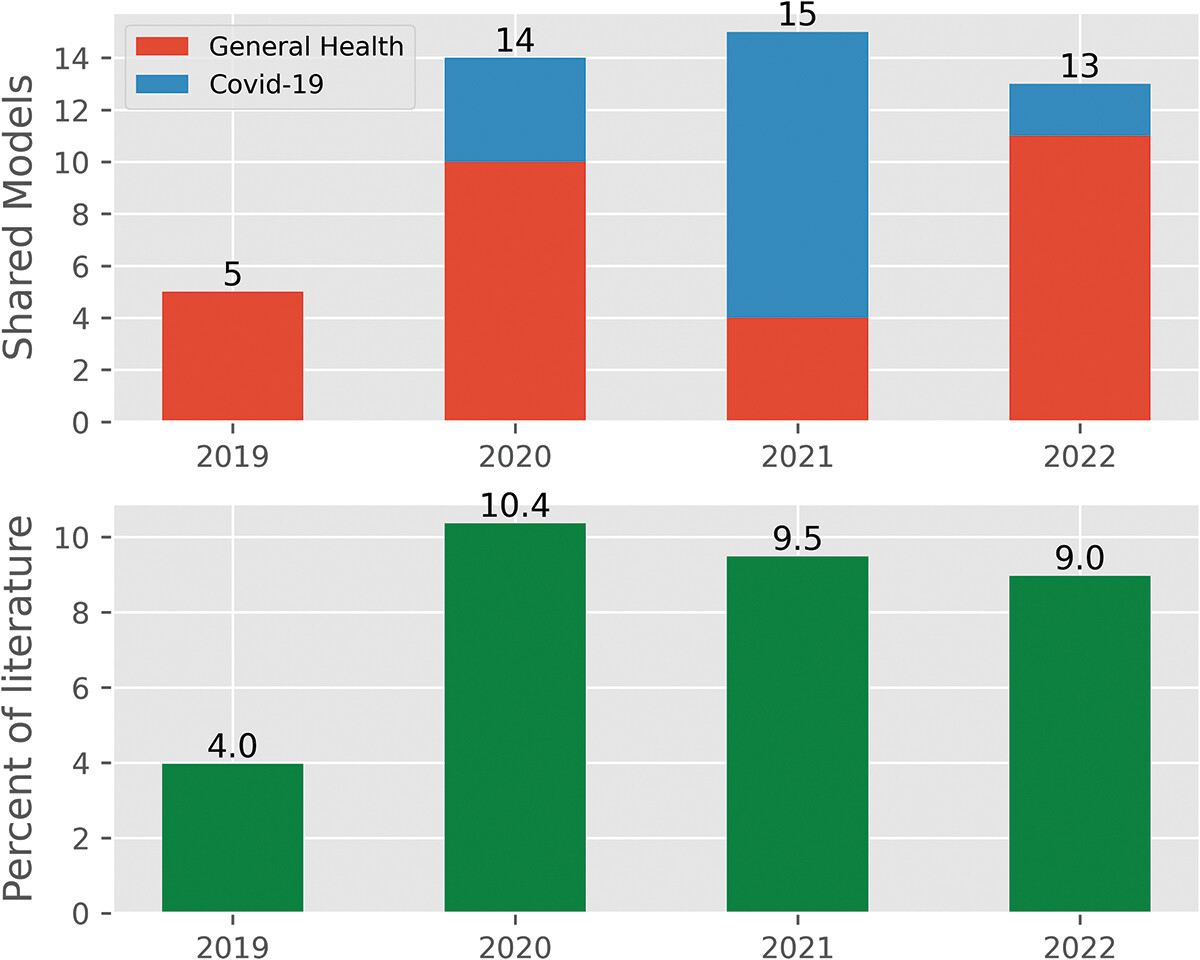
In total, 47 (8.3%) of the included 564 studies cited an openly available DES computer model that was used to generate their results. Of these 47, the majority (n = 29) of models were developed using FOSS tools
The proportion of the literature that cited an openly available DES computer model increased from 4.0% in 2019 to 9.0% in 2022; the years 2020–2022 were similar in proportion. The figure below illustrates this, with models split by year and whether they focused on COVID-19.
Model audit
The table shows the results or out audit, split by code and VIM-based models. VIM are Visual Interactive Modelling software (VIM; e.g., Arena, Anylogic, or Simio).
| Practice | CODE (%) | VIM (%) |
|---|---|---|
| Model has DOI | 4 (12.9) | 3 (18.8) |
| ORCID | 3 (9.7) | 3 (18.8) |
| Licensed | 15 (48.4) | 6 (37.5) |
| Readme | 21 (67.7) | 7 (43.8) |
| Steps to run | 13 (41.9) | 3 (18.8) |
| Formal Dep Mgt | 7 (22.6) | n/a |
| Informal Dep Mgt | 7 (22.6) | 8 (50.0) |
| Evidence of testing | 3 (9.7) | n/a |
| Model downloadable | 31 (100.0) | 11 (68.8) |
| Model interactive online | 4 (12.9) | 6 (37.5) |
Online supplementary appendix
We created a Jupyter Book to serve as an online supplementary appendix, providing greater detail on the review results. This can be viewed at https://tommonks.github.io/des_sharing_lit_review. The codebase behind this website is open and available at https://github.com/TomMonks/des_sharing_lit_review.
Zotero
We created a Zotero online database with studies that shared computer simulation models: https://www.zotero.org/groups/4877863/des_papers_with_code/library.
Subsequent work
Following on from this review, we developed the STARS framework for model reuse, which provides practical guidance to help improve the reusability of shared healthcare DES models.
Publication
This page was written by Amy Heather and reflects her interpretation of this work, which may not fully represent the views of all project authors or affiliated institutions.